Author: jettins_rhxsky

When the combines are finally parked and the last loads are in, the farm gets a chance to catch its breath. The long days in the field may be winding down, but the work isn’t over. Early November is a useful transition window: a chance to put equipment away properly, finish up seasonal chores, and get buildings and livestock systems ready for Indiana winter.

Every farm has its own rhythm and priorities. You know your land, equipment, and operation better than anyone. Here are some practical places to turn your attention as harvest wraps up, and a few reasons those end-of-season tasks matter.

Put the iron away with care

Before a combine, tractor, or implement settles in for the winter, give it a good clean. Crop residue, mud, and moisture can take a toll while machinery sits. Follow the manufacturer’s guidance for cleaning, service, fluids, batteries, and storage; make a note of repairs that can be handled before the next busy season.

Choose a dry, secure storage spot when possible, and leave room to move around equipment safely. If machinery has to sit outdoors, consider what is exposed to weather and whether it can be positioned to reduce avoidable wear. A few minutes spent organizing the shed now can also make it easier to get to the machine or tool you need later.

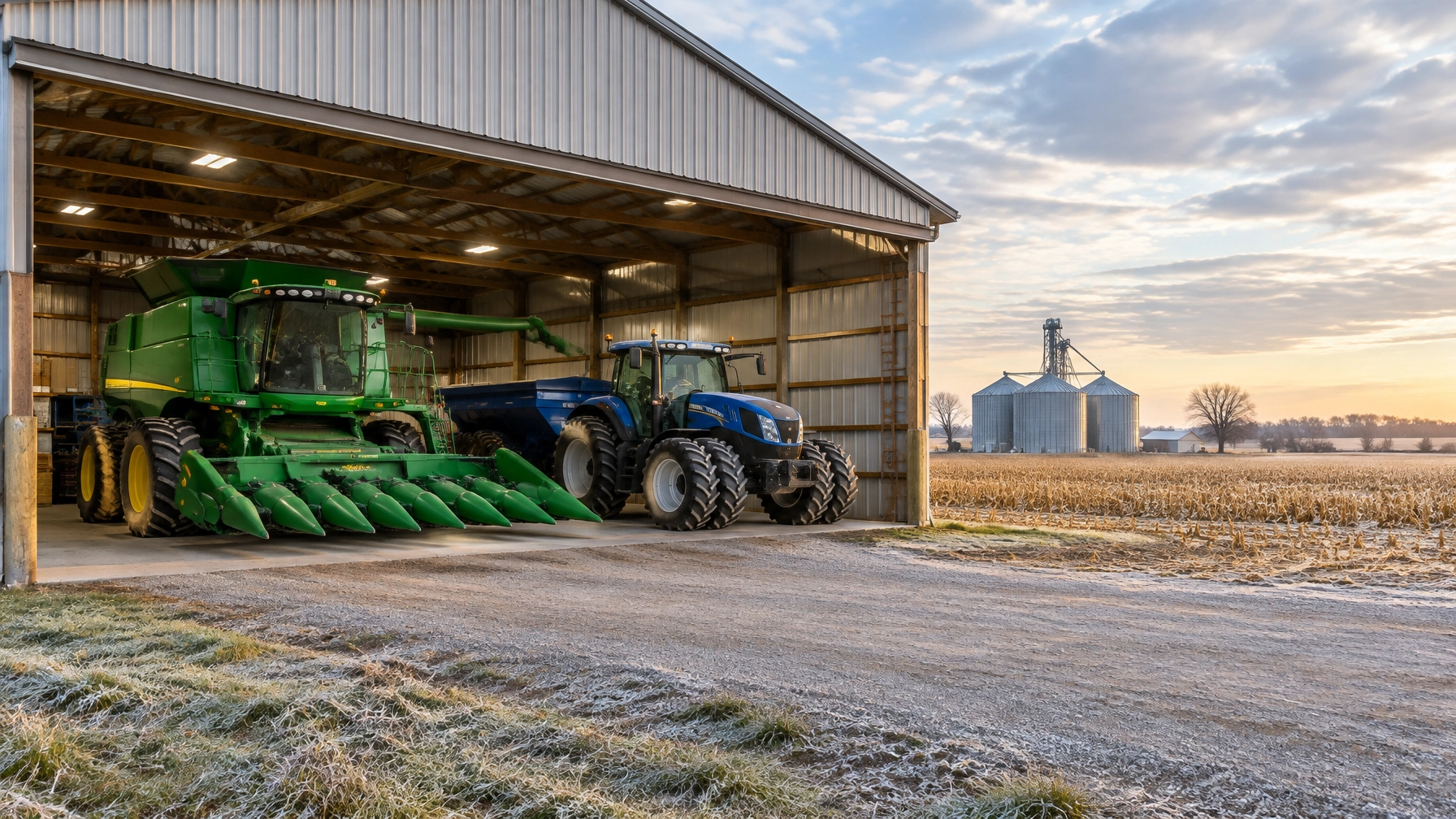
Farmer inspecting parked farm machinery inside a shed after harvest

Think, too, about what else shares the building. Hay, fuel, chemicals, and machinery all have different storage needs. Keeping areas orderly, following product labels, and maintaining clear access around equipment can help reduce hazards and make routine checks easier.

Finish the grain move, and tidy the storage areas

After harvest, grain may still be moving from the field to bins, a dryer, or market. Take care around augers, conveyors, trucks, and other equipment, and keep walkways and work areas as clear as the job allows. Grain bins and dryers deserve particular attention: follow operating and safety guidance, and don’t enter a bin unless you’re trained and equipped to do so.

Once the busy work settles, clean out equipment sheds and work areas. Remove accumulated chaff and dust where it is safe to do so, and put tools, cords, and supplies where they belong. A cleaner space is easier to inspect, and easier to work in when winter repairs can’t wait.

Fuel and chemicals need careful handling, too. Store them in appropriate, clearly identified containers and locations, follow label instructions, and keep them away from heat sources and ignition hazards. If you’re unsure how a particular product should be stored for winter, check its label or ask the supplier.

Walk the farm while the equipment is down

Equipment downtime creates a good opportunity to walk the property. Check fences, gates, and access points. Look over barn and shed roofs from a safe vantage point, clear gutters where practical, and note tree limbs hanging over buildings, driveways, or power lines.

That walk can help you spot small issues before snow, ice, or frozen ground makes them harder to address. A loose gate, blocked drainage path, or damaged roof section may be easier to deal with now than in the middle of a winter storm.

Farmer walking a late-fall Indiana farm to inspect a barn, roof, and fence line

For roofs and other structures, don’t take chances to get a closer look. If a building appears damaged, sagging, or otherwise unsafe, keep people and animals clear and seek qualified help. Heavy snow and ice can add stress to barns and sheds, and uneven drifting can create trouble where it piles up.

Get water and livestock systems ready

A frozen pipe in an outbuilding or grain-dryer shed can be more than an inconvenience. Identify vulnerable lines, shutoffs, and drain points. Insulate exposed pipes where appropriate, disconnect outdoor hoses, and follow manufacturer instructions for heat tape or other protective equipment. The Indiana Office of Utility Consumer Counselor’s frozen-pipe guidance offers useful general advice, including a clear warning: never try to thaw a frozen pipe with an open flame.

Livestock water systems need attention before a hard freeze, not after the water stops flowing. Test heated waterers and check the parts you rely on. Have a practical backup plan for keeping water available during a power interruption. Purdue Extension notes that livestock need access to thawed water in winter and that snow alone generally won’t meet their water needs. Read more in Purdue Extension’s guidance on protecting livestock during winter storms.

Farmer checking a livestock waterer in a clean barn before winter

Take fire and cold-weather risks seriously

Space heaters and heat lamps can be useful in the right setting, but they also bring fire risk. Use equipment according to its instructions, keep combustible materials well away, and avoid damaged cords or makeshift electrical setups. Check that the barn’s electrical and heating equipment is in suitable working order, and make sure people on the farm know what to do if a fire starts.

Cold weather can also affect machinery. Batteries, tires, fluids, and exposed components may need seasonal attention based on the equipment maker’s recommendations. Rodents can damage wiring and hoses, so keep storage areas tidy and check on parked machinery during the winter rather than assuming it will be fine until spring.

And remember the roads. Rural routes can become slick quickly during freezing rain or an ice storm. Give yourself extra time, use caution with farm vehicles and loaded trailers, and consider whether a trip can wait until conditions improve.

Use the quieter stretch to get organized

Harvest’s end can bring a welcome pause, even if there are still chores on the list. It can also be a convenient time to organize farm records and note changes from the season while they’re fresh. Many farm insurance policies renew near year-end. Knowing your renewal date now is better than discovering in February that you need to ask questions in a hurry.

That doesn’t mean every operation needs the same insurance setup. Farms differ in buildings, equipment, crops, livestock, and day-to-day work. Coverage options also vary by carrier, location, and underwriting, and are subject to policy terms, conditions, and exclusions.

At Jett Insurance, we’re an independent agency that works with multiple carriers and can compare farm insurance options side by side. Our approach is personal because one size doesn’t fit every farm. We’ve served Indiana farm families since 1990, and we understand that a farm is both a livelihood and a home. You can learn more about our perspective in our article for Indiana farm operations.

The combines may be parked, but a little thoughtful attention now can make the transition into winter smoother. Take the walk, finish the seasonal chores that matter most to your operation, and make time for the paperwork while harvest is behind you.

When it’s convenient, call Jett Insurance at (765) 987-7019 or visit www.jettins.com to talk with us about a farm policy review. We’re based in Lewisville, Indiana, and happy to help you understand your options.

A tiny chip in your windshield can be easy to overlook, until a cold morning, a blasting defroster, or another bump in the road turns it into a crack stretching across your view. Indiana winters bring plenty of conditions that can damage auto glass, and once glass is damaged, the repair can become more involved.

Before temperatures plunge, it’s worth checking how your auto policy handles windshield and other glass damage. Here’s what Indiana drivers should know about winter glass damage, comprehensive coverage, and options that may help with a deductible.

Why winter is tough on auto glass

Winter roads can send gravel and debris flying. Snow plows and salt trucks help make roads safer, but the loose material they leave behind can be kicked up by passing vehicles. Rocks and other debris can also strike your windshield as you travel on treated or uneven winter roads.

Cold weather adds another challenge. A small chip can spread when temperatures swing or when cold glass is heated quickly. Frozen ice, falling branches, and the everyday bumps of winter driving can add to the risk.

Close-up of a small windshield chip on a frosty car in winter

How a small chip can become a big problem

Glass expands and contracts as its temperature changes. If a windshield is cold and you suddenly direct warm air from the defroster onto one area, the difference in temperature can put stress on the glass. A chip is already a weak point, so that extra stress may cause it to spread into a crack.

The same principle is why you should never pour hot water on a frozen windshield. The sudden temperature change can damage the glass, and water may freeze again as it runs across the windshield. Use your defroster gradually and clear softened ice with a plastic scraper or another appropriate tool. AAA offers additional windshield de-icing guidance.

What auto glass coverage usually means

Windshield and other glass damage is typically handled under comprehensive coverage on an auto policy. Comprehensive generally applies to certain kinds of damage other than a collision. Glass breakage is one example. If the glass breaks as part of a crash, collision coverage may be relevant instead.

A deductible may apply when you make a comprehensive claim. Some insurance carriers also offer a full-glass option or another arrangement that waives or reduces the deductible for eligible glass damage. These options aren’t available on every policy, and details vary by carrier and policy.

That’s why it’s helpful to check your declarations page or ask your agent:

  • Do I have comprehensive coverage?
  • What deductible applies to glass damage?
  • Does my policy offer full-glass coverage or a separate glass deductible?
  • Are repairs and replacements treated differently under my policy?

Coverage is subject to policy terms, conditions, and exclusions, and availability varies by carrier, location, and underwriting. The Indiana Department of Insurance auto insurance guide explains that comprehensive coverage can include glass breakage and that a deductible may apply.

Repair or replacement? It depends on the damage

A small chip may be repairable, especially if it’s addressed promptly. A qualified glass technician can assess its size, location, and condition. Repairing a chip may take less time and cost less than replacing a windshield, but the right option depends on the damage and the technician’s assessment.

A crack that’s spreading, damage near the edge of the glass, or damage that interferes with the driver’s view may require a full replacement. If your vehicle has cameras or sensors around the windshield, ask the installer whether they need to be recalibrated after replacement.

Auto-glass technician inspecting a windshield chip in a service bay

Don’t wait for a chip to grow before having it looked at. Dirt, temperature changes, and normal driving can make damage more difficult to address. If a crack affects your visibility, get professional guidance before driving.

What to do if you notice windshield damage

A few simple steps can help you make a clear decision and avoid surprises:

  1. Take photos. Document the damage and where it appears on the glass.
  2. Check your policy. Find out whether comprehensive coverage applies and ask how your deductible works for glass.
  3. Contact your insurer or agent promptly. Ask about your options and any claim steps before authorizing work.
  4. Get the damage assessed. A qualified glass professional can tell you whether repair is appropriate or replacement is needed.
  5. Act before the chip spreads. Addressing damage early may leave you with more repair options.

Driver in winter gloves safely scraping frost from a car windshield

Don’t assume glass is automatically covered, or that a claim never makes sense

Two common assumptions can trip drivers up: “My insurance automatically covers every glass repair,” and “It’s never worth contacting my insurer for a chip.” Neither is true for every policy or situation.

Whether coverage applies, what deductible you’ll pay, and whether it makes sense to file a claim depend on your policy and the damage. A quick review can help you understand what you have before winter weather puts it to the test.

Get your glass coverage checked before the first hard freeze

At Jett Insurance Agency, we know one auto policy doesn’t fit every driver. As an independent agency, we can review your current coverage and compare options from multiple insurance carriers to help you find a comprehensive and glass setup that fits your needs. We’ve been serving clients since 1990, with a personalized approach to insurance.

Before the first hard freeze, call Jett Insurance at (765) 987-7019 or visit jettins.com for a free auto policy review, including a check of your glass and comprehensive coverage. We’re located in Lewisville, Indiana, and we’re happy to help you understand what your policy says before a small chip becomes a winter headache.

Coverage varies by carrier, location, and underwriting and is subject to policy terms, conditions, and exclusions. A review can help explain your current policy but does not guarantee coverage or a claim outcome.

Life insurance can feel like a project you keep meaning to get to: compare options, fill out forms, schedule an exam, then wait for an answer. But some life insurance applications are designed to move much faster. With an online process, you can answer a few questions, get a quote, and apply from home, often in minutes.

At Jett Insurance Agency, we’ve added five online life insurance options to our life insurance page. They’re built for different needs, from term coverage for people protecting a household to options designed for final expenses. Here’s what “instant underwriting” means, what it doesn’t mean, and how to explore the choices.

What does “instant underwriting” mean?

Underwriting is how an insurance company reviews an application to decide whether it can offer coverage and on what terms. An instant or accelerated process uses an online application and a faster review path, rather than relying on a long, paper-heavy process for every applicant. Depending on the product, the application may ask health or other questions, or, for some options below, no health questions.

The key point: a quick online application is not the same as guaranteed approval or immediate coverage. An online quote is an estimate based on the information provided. The insurer still applies its eligibility rules, and coverage takes effect according to the policy documents. The National Association of Insurance Commissioners’ overview of accelerated underwriting also explains that faster underwriting is still underwriting.

A couple completing an online insurance application at home

What the online process looks like

The quote paths are designed to be straightforward:

  1. Choose an option that fits what you’re looking for.
  2. Answer a few questions in the online application. The questions vary by product; some options ask health questions, while others do not.
  3. Review your quote and continue through the application if you want to apply.
  4. Complete the online steps, including SMS verification where required.
  5. Check the insurer’s decision and policy details. If coverage is offered, review the terms and effective date carefully.

The time needed and the outcome can vary. Plans, rates, coverage, and eligibility vary by age, health history, state, and underwriting. A fast application can make it easier to get started, but it doesn’t remove the importance of choosing coverage that suits your needs.

Five options to explore

Each link below opens its own quote and application path. Eligibility ages are general guides only; confirm current availability and requirements with an agent and the insurer.

1. Term with Living Benefits

Get a quote for Term with Living Benefits

This term life option includes living benefits riders, with options such as an Accidental Death Benefit or Dependent Child rider available. The application includes health questions. It may be worth exploring if you’re looking for term coverage and would like to review available rider options as part of the application.

Term products are generally for ages 18–60, subject to carrier rules. Rider availability, benefits, and eligibility depend on policy terms, conditions, and exclusions.

2. Pure Term

Get a quote for Pure Term

Pure Term is a straightforward term life option. The application includes health questions. It may suit someone who wants to explore term coverage without focusing on the living-benefit rider options listed with the first product.

Term products are generally for ages 18–60, subject to carrier rules. The quote and application will show the available options and terms for your situation.

3. Accidental Death

Get a quote for Accidental Death

This option has no health or nicotine questions and uses a few quick application steps. It may appeal to someone looking for coverage focused on accidental death. Be sure to review the policy’s definition of a covered accident, as well as its conditions and exclusions, before applying.

The general age range is 20–59, subject to carrier rules and availability.

4. Final Expense

Get a quote for Final Expense

Final Expense is designed to help with end-of-life costs, such as funeral expenses. This application does not ask health questions. It may be an option for people who want to consider how certain expenses could be handled by their loved ones.

The general age range is 50–85, subject to carrier rules and availability. Review the policy carefully to understand its benefits, terms, conditions, and exclusions.

5. Guaranteed Issue

Get a quote for Guaranteed Issue

This option offers guaranteed acceptance and does not ask health questions. It may be worth exploring if health questions have been a barrier to applying for coverage. “Guaranteed acceptance” applies within the product’s eligibility rules and does not replace reviewing the policy details.

The general age range is 50–85, subject to carrier rules and availability. Read the application and policy documents to understand the coverage and any applicable conditions or exclusions.

A mature couple talking together at home

When does a no-health-question option make sense?

A no-health-question application may feel simpler for someone who wants to avoid answering health questions as part of the application process. It can also be a useful option to explore if health concerns have made applying feel daunting.

Keep in mind that no health questions doesn’t automatically mean a policy is the right fit, or that all products work the same way. Compare the purpose of the coverage, eligibility, policy terms, and the quote you receive. If you’re unsure which option matches your situation, a conversation with an agent can help you understand what to look for.

If you’re shopping for coverage to support a partner or children, consider what financial responsibilities you want the policy to help address. If your focus is end-of-life costs, compare the final expense and guaranteed issue options and read their terms carefully. There isn’t one choice that fits everyone.

How to get started through Jett Insurance

Visit our life insurance page and select the quote link for the option you’d like to explore. You can start online, answer the questions for that product, and follow the application steps, including SMS verification if requested.

The links are powered by Fidelity Life products. The final application and policy documents provide the details that matter: eligibility, coverage, exclusions, conditions, and when coverage would take effect. Take time to review them before making a decision.

Jett Insurance Agency is an independent agency based in Lewisville, Indiana, and has served clients since 1990. If you’d like help understanding the options before applying, call (765) 987-7019 or visit www.jettins.com. We’re happy to help you take the next step at your pace.

Important: Plans and rates vary. Coverage, pricing, and eligibility vary by age, health history, state, and underwriting. Product benefits and eligibility are subject to policy terms, conditions, and exclusions. Age ranges are general guidelines and should be verified with an agent and the carrier. An online quote or application is not a guarantee of coverage.

Usage-based auto insurance can sound like an easy win: share information about how you drive, and you may qualify for a discount. But telematics programs don’t all work the same way, and a discount is not always guaranteed. Depending on the insurer and program, your premium could go down, stay the same, or, where the rules allow, go up.

The right question isn’t simply, “How big is the advertised discount?” It’s whether the program’s actual terms, potential savings, and data practices suit your driving and your comfort with sharing information.

What is usage-based auto insurance?

Usage-based insurance (UBI), sometimes called telematics insurance, uses driving data to help an insurer assess how a vehicle is used. Data may be collected through a smartphone app, a plug-in device, or technology built into a vehicle. The National Association of Insurance Commissioners (NAIC) explains that programs may track mileage, time of day, location, and driving events.

Some programs focus mostly on how far you drive. Others evaluate driving habits, and some combine both. An insurer may use the information alongside traditional rating factors to determine whether a program discount or premium adjustment applies. The specific formula and consequences depend on the carrier, policy, and state.

A smartphone mounted in a car showing a generic trip-summary screen

What driving behaviors can affect your rate?

Each insurer sets its own program rules, but telematics may measure or consider:

  • Mileage: Less time on the road may matter in some programs, especially pay-per-mile plans.
  • Time of day: Frequent late-night driving may affect a score with some carriers.
  • Braking and acceleration: Repeated hard stops or rapid starts may count as risk indicators.
  • Cornering and speed: Sharp turns or speeding may be considered in certain programs.
  • Phone use: Some apps can detect potential phone distraction while driving.
  • Location and trip patterns: GPS-based programs may record where and when trips occur.

These measurements are not a universal checklist. A behavior that affects one carrier’s score may not be used by another, and a single event, such as braking suddenly to avoid a hazard, may not tell the whole story. Ask how the program evaluates events and what happens if a trip is recorded incorrectly.

The potential benefits, and the tradeoffs

The main appeal is the chance to have your premium reflect your mileage or driving habits. If you drive relatively few miles, tend to drive smoothly, and the program’s scoring rules align with your routines, participation may be worthwhile. Some programs may also provide feedback that helps you notice patterns and encourage safer habits.

But it’s important to look beyond a maximum advertised discount. A maximum is not a promise of what you will save. Some plans offer an initial participation discount; others assess driving data over time and apply a discount, no change, or a possible increase at renewal. The Washington State Office of the Insurance Commissioner similarly notes that premiums may go up or down and that not every driver will meet a program’s requirements for a discount. See its consumer guide to usage-based insurance.

Results can vary even among drivers who consider themselves careful. Commute schedules, unavoidable trips, driving frequency, and how the app interprets events may affect the outcome. One illustration of that variability: a Consumer Federation of America analysis of Maryland’s 2023 telematics data reported that 31% of enrolled drivers had a premium decrease, 45% saw no change, and 24% had an increase. Those figures describe that state and year, not all drivers or all programs, but they’re a useful reminder to check the details before enrolling.

A navy compact car parked in a quiet residential driveway

Privacy deserves a close look

Telematics may reveal more than how gently you brake. Depending on the technology and program, it can involve information about trips, locations, timing, mileage, and driving events. With connected cars, information may also pass through a vehicle manufacturer or a service provider working with the insurer.

Before signing up, read the program terms and privacy notice. Find out:

  • What information is collected, and when?
  • Is location data collected continuously or only during trips?
  • Who receives or processes the data, including third-party providers?
  • How long is it kept, and can it be shared for purposes beyond calculating a discount?
  • Can data be used in claims or underwriting?
  • How can you review or correct a trip or score you believe is inaccurate?
  • What happens to the data, and to your premium, if you leave the program?

The answers can vary by carrier and state. The NAIC’s overview of telematics describes privacy as one of the issues raised by collecting mileage and driving-behavior information. If a program uses a phone app, check its permissions and make sure you understand when location access is active.

A close-up of a generic telematics plug and a smartphone with abstract privacy controls

What to verify before enrolling

A short conversation with your insurer or agent can help you compare the program’s real terms with your expectations. Ask:

  1. Can my premium increase? Confirm whether poor results can lead to a higher premium, or whether the program only offers discounts.
  2. What is guaranteed, and what isn’t? Separate any participation discount from a possible renewal discount. Ask whether an advertised maximum is available to everyone or only under specific conditions.
  3. How is the score calculated? Ask which behaviors matter, what the evaluation period is, and how much mileage or how many trips are required.
  4. How do shared vehicles work? Find out whether every driver needs to enroll and how the app distinguishes drivers.
  5. What if the technology gets it wrong? Ask how you can review and dispute an incorrect trip or event.
  6. What does opting out mean? Check whether you can leave at any time and whether doing so changes your premium or removes an existing discount.
  7. Does the policy still fit my needs? Compare the full premium and coverages, not only the telematics line item, with your current policy.

Because program details and state rules differ, get answers for the specific carrier and policy you’re considering. You can also check with your state insurance department if you want to learn about local consumer protections.

So, are telematics discounts worth it?

They may be worth considering if you drive fewer miles, are comfortable with the required data collection, and understand exactly how your score affects your premium. They may be a poor fit if your insurer can surcharge you, your daily driving is unlikely to match the scoring criteria, or you don’t want location and trip information collected.

At Jett Insurance Agency, we believe insurance should fit the person, not the other way around. As an independent agency, we can help clients compare options from multiple providers, but program availability and rules vary by carrier. We won’t promise a particular discount; we’ll help you understand what to ask and compare the full policy and price.

If you’re reviewing your auto coverage, start with our auto insurance information or contact Jett Insurance to talk through your options. A telematics program is one factor to consider, not a substitute for checking that your coverage fits your needs.

Turning a home, lake cabin, or guesthouse into a short-term rental can be a great way to welcome visitors and earn rental income. But opening your property to a rotating stream of guests changes how it’s used, and that can change how insurance responds.

Whether you host on Airbnb, Vrbo, or through direct bookings, it’s worth checking your coverage before the next guest arrives. Here are the main risks and questions Indiana hosts should consider.

A short-term rental isn’t just a home with a guest

A long-term tenant and a short-term guest use a property differently. Short stays can mean frequent check-ins, unfamiliar visitors, more wear and tear, and a business activity taking place at the property. A standard homeowners policy may limit or exclude coverage for regular short-term rentals, including some guest injuries or damage connected with renting.

That doesn’t mean every policy works the same way. The details depend on the insurer, the property, how often it’s rented, and the policy language. The National Association of Insurance Commissioners explains why home-sharing can affect homeowners coverage. The key takeaway: don’t assume your current policy covers a paid stay. Tell your insurer how you actually use the property and ask what protection applies.

A host welcoming travelers at the entrance to a rental home

What can go wrong between check-in and checkout?

A guest can slip on the steps, trip on an uneven path, or get hurt using an amenity. A guest might accidentally damage furniture, or, in some cases, cause damage deliberately. Theft, vandalism, and disputes over what happened can also become stressful and costly.

Think beyond the main house, too. A detached garage, shed, or guesthouse may need to be included in the coverage conversation. Furnishings, appliances, linens, electronics, and other items you provide for guests may be treated differently from your personal belongings.

And if the property has a pool, hot tub, fire pit, or other feature that requires extra care, ask how its use affects liability coverage. Safe maintenance, clear guest instructions, and appropriate barriers are important risk-management steps, but they don’t replace insurance.

What kind of insurance should hosts ask about?

Depending on the property and its use, a carrier may offer a short-term rental or vacation-rental policy, an endorsement, or another suitable arrangement. A landlord-style policy may be an option in some circumstances, but not every landlord policy is designed for frequent, short guest stays. Ask specifically whether the proposed coverage allows the type and frequency of rental you plan to offer.

A policy designed for short-term rental use may address areas such as:

  • The building and other structures: The home and eligible detached structures, subject to policy terms, conditions, and exclusions.
  • Liability: Certain claims involving guest injuries or damage to someone else’s property, subject to policy terms, conditions, and exclusions.
  • Furnishings and contents: Items you keep at the rental, subject to policy terms, conditions, and exclusions.
  • Rental income: Lost income after a covered event makes the property unlivable, if the policy includes applicable coverage and the loss meets its requirements.

Don’t assume that damage to your property or canceled bookings are automatically covered just because the building is insured. Ask what causes of loss qualify, what documentation is needed, and how long any income-related coverage may apply. Coverage varies by carrier, location, and underwriting; all coverage is subject to policy terms, conditions, and exclusions.

A furnished rental home with guest-ready living and dining areas

Platform protection can help, but it isn’t your insurance policy

Airbnb and Vrbo offer host protection programs, but they are not substitutes for insurance you arrange for your property. Their programs have their own definitions, exclusions, conditions, and claim processes. Whether a program applies can depend on the incident, the reservation, and how the booking was handled.

For example, Airbnb describes Host liability insurance and separate Host damage protection. Airbnb says its Host damage protection is not an insurance policy and doesn’t replace insurance obtained by the host. Review Airbnb’s current Host damage protection terms and Host liability insurance information rather than relying on a summary, or assuming the program covers every possible loss.

Vrbo also describes a liability program with specific requirements and terms. Its liability insurance information is worth reviewing, but liability protection should not be mistaken for comprehensive coverage for your building, belongings, or rental income.

Use platform programs as a possible extra layer, not as your only plan. Ask your agent how the platform’s protection interacts with your own policy and what gaps may remain.

Indiana hosting has its own local details

Indiana hosts may welcome visitors to lake cabins, provide lodging during hunting season, or rent a home during a local festival or sporting event. Those uses can bring different booking patterns and different questions about occupancy, property features, and local requirements.

Check with the city, town, or county where the property is located about zoning, permits, safety rules, taxes, and any applicable homeowners association or condominium restrictions. Local requirements can differ from one community to another. For instance, Whitestown’s Code Compliance page provides local guidance on short-term rentals. It’s an example, not a rulebook for every Indiana community, so contact the relevant local offices for your property.

Water deserves attention, too. Storm damage, water entering from outside, and sewer or drain backup may be treated differently under insurance policies. Don’t assume that a policy covering some kinds of water damage also covers flooding. The Indiana Department of Insurance’s flood insurance resource is a useful starting point for understanding flood coverage. Ask an agent what applies to your specific property and whether building, contents, and rental-income concerns need separate consideration.

A practical checklist before the next booking

A short review now can help you understand what to expect before a claim happens:

  1. Tell your insurer before you list. Explain how often you’ll rent, which platforms or booking methods you’ll use, and whether guests can use features such as a pool, hot tub, or fire pit.
  2. Ask about the whole property. Discuss the main home, detached structures, furnishings, appliances, liability, and rental income.
  3. Keep good records. Save receipts for furniture, equipment, improvements, and repairs. Take dated photos and keep an inventory of items supplied for guests.
  4. Check local rules. Confirm applicable requirements with local authorities and review any HOA or condominium rules.
  5. Review before busy seasons. A lake cabin before summer, a hunting-season rental, and a home listed for local events may have different booking patterns. Check that your insurer knows about changes in use.
  6. Ask about umbrella liability. An umbrella policy may be worth discussing, but confirm that it can apply to your rental activity and understand its limits and exclusions.

A host reviewing rental property paperwork and a coverage checklist

Get a review that fits how you host

There isn’t one short-term rental policy that fits every Indiana property. A lake house with a dock, a furnished home rented during local events, and a small guesthouse may call for different conversations about use, property features, and liability.

Jett Insurance Agency is an independent agency that can compare options from multiple insurance providers and help you explore coverage suited to how you actually use the property. We’ve served clients since 1990, and our approach is personal: one size doesn’t fit all.

For a free review of your short-term rental property’s coverage before the next booking season, call 765-987-7019 or visit www.jettins.com. We’ll help you identify questions to ask and options to consider. Coverage varies by carrier, location, and underwriting and is subject to policy terms, conditions, and exclusions.